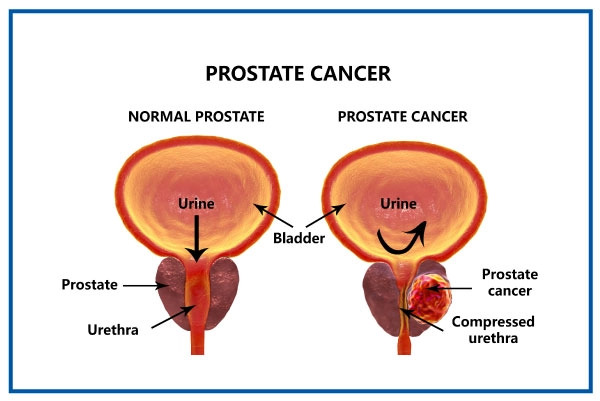
Prostate cancer is a type of cancer that begins in the prostate gland, a small walnut-shaped organ found only in men.
The prostate is located just below the bladder and in front of the rectum, and its main function is to produce the fluid that nourishes and transports sperm (seminal fluid).
Prostate cancer occurs when the cells in the prostate start to grow uncontrollably. Most prostate cancers are adenocarcinomas, which develop from the gland cells that make prostate fluid.
How Prostate Cancer Develops
Like other cancers, prostate cancer develops when changes (mutations) occur in the DNA of prostate cells. These mutations cause the cells to grow and divide more rapidly than normal cells, forming a tumor.
If left untreated, the cancer may grow beyond the prostate and spread (metastasize) to nearby tissues, lymph nodes, or bones.
Risk Factors
Several factors can increase the risk of developing prostate cancer:
-
Age: The risk rises significantly after age 50.
-
Family history: Having a father or brother with prostate cancer doubles the risk.
-
Race: More common and often more aggressive in Black men.
-
Genetic mutations: Inherited mutations in genes such as BRCA1, BRCA2, or HOXB13.
-
Diet and lifestyle: High-fat diets, obesity, and lack of physical activity may play a role.
-
Hormonal factors: Testosterone and other male hormones (androgens) can influence prostate cell growth.
Symptoms
In early stages, prostate cancer may cause no symptoms. As it grows, possible signs include:
-
Difficulty starting or stopping urination
-
Weak or interrupted urine stream
-
Frequent urination, especially at night
-
Pain or burning during urination or ejaculation
-
Blood in urine or semen
-
Pain in the back, hips, or pelvis (if cancer has spread)
These symptoms can also occur with noncancerous conditions like benign prostatic hyperplasia (BPH) or prostatitis, so proper medical evaluation is essential.
Diagnosis
Prostate cancer is diagnosed using a combination of tests:
-
PSA test (Prostate-Specific Antigen): Measures PSA levels in the blood; high levels may indicate prostate cancer.
-
Digital Rectal Exam (DRE): A doctor examines the prostate for lumps or irregularities.
-
Imaging tests: MRI, ultrasound, or CT scans help visualize the prostate.
-
Biopsy: Tissue samples from the prostate are examined under a microscope to confirm cancer.
-
Gleason score: Indicates how aggressive the cancer cells look under the microscope (scale 6–10).
Staging
Prostate cancer stages describe how far the cancer has spread:
| Stage | Description |
|---|---|
| Stage I–II (Localized) | Cancer confined to the prostate. |
| Stage III (Locally Advanced) | Cancer has spread to nearby tissues. |
| Stage IV (Metastatic) | Cancer has spread to distant organs (e.g., bones or lymph nodes). |
Treatment Options
Treatment depends on the stage, age, health, and patient preference. Common treatments include:
-
Active surveillance (watchful waiting) for slow-growing cancers.
-
Surgery (radical prostatectomy) to remove the prostate gland.
-
Radiation therapy (external beam or brachytherapy).
-
Hormone therapy (androgen deprivation therapy) to lower testosterone levels.
-
Chemotherapy for advanced or resistant cancers.
-
Targeted therapy and immunotherapy for specific genetic or advanced cases.
Outlook
-
Most prostate cancers grow slowly, and many men live long, healthy lives even with the disease.
-
The five-year survival rate for localized and regional prostate cancer is over 98% when detected early.
-
Advanced prostate cancer can often be managed for many years with modern treatments.
Prevention
While prostate cancer cannot always be prevented, risk can be lowered by:
-
Maintaining a healthy weight
-
Eating a balanced diet rich in fruits and vegetables
-
Exercising regularly
-
Avoiding smoking and excessive alcohol
-
Discussing screening (PSA testing) with a doctor, especially for men over 50 or those with family history